Visual examples
Preserve types and resolve nested values
A placeholder occupying the entire value preserves its type: numbers and booleans reach the API as numbers and booleans.
from paylo import render_template

body = render_template(
    {"name": "{{customer.name}}", "active": "{{active}}", "count": "{{count}}"},
    {"customer": {"name": "Ana"}, "active": True, "count": 3},
)
assert body == {"name": "Ana", "active": True, "count": 3}
Create a payload from Robot Framework
Reuse the dictionary from each iteration; Paylo prepares the payload and RequestsLibrary sends the request.
*** Settings ***
Library    Paylo

*** Test Cases ***
Create Payload From Data
    VAR    &{values}    name=Ana    active=${True}    quantity=${3}
    ${body}=    Render JSON    {"name":"{{name}}","active":"{{active}}","quantity":"{{quantity}}"}    ${values}
    Should Be Equal    ${body}[active]    ${True}
    Should Be Equal As Integers    ${body}[quantity]    3
Detect missing variables
A missing variable raises an explicit error before sending a request.
from paylo import render_template, MissingVariableError

try:
    render_template({"email": "{{email}}"}, {})
except MissingVariableError as error:
    print(error)
Result screenshot
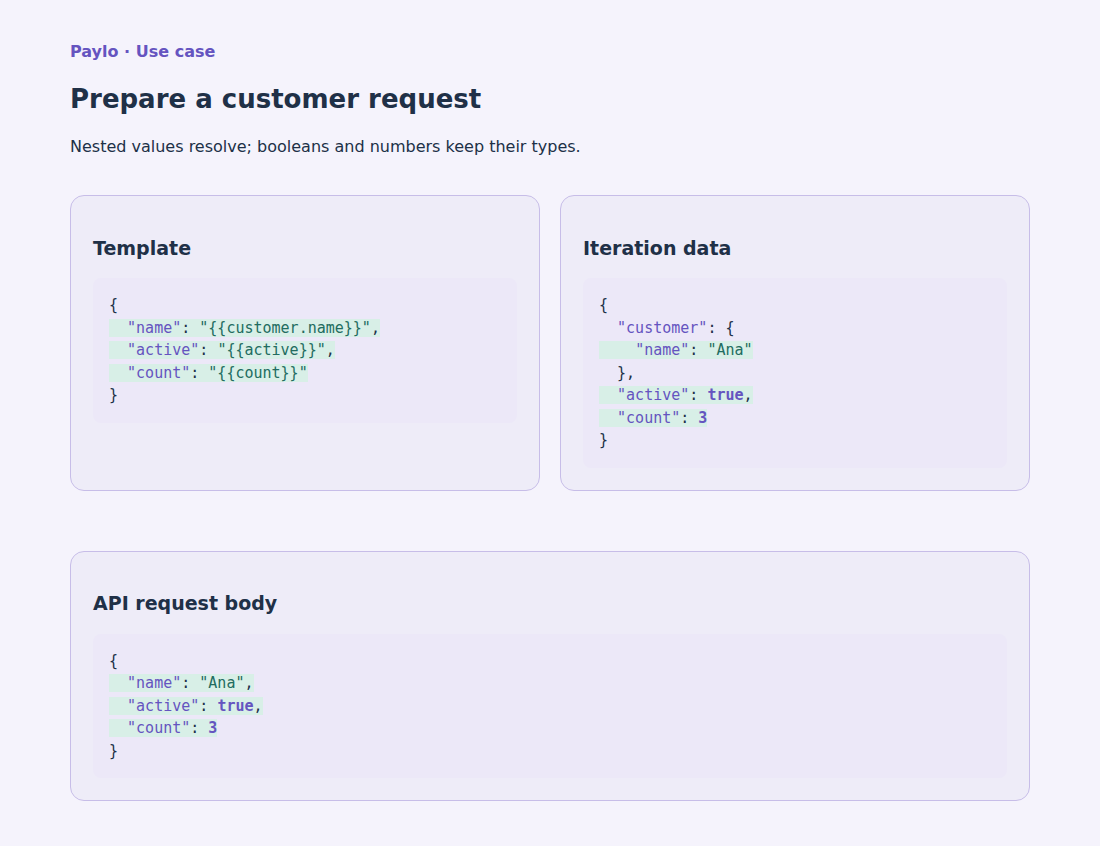
This capture is generated by the Python Paylo engine from the typed, nested-value example above. It shows the template, iteration data and resulting request body; it is independent of the interactive demo.
Interactive demo
The demo follows the documentation language and lets you experiment with values. It is a JavaScript simulation; the examples above execute the Python library.
[{"name": "English", "lang": "en", "link": "/robotframework-paylo/examples/", "fragments": {"visual-examples": "visual-examples", "preserve-types-and-resolve-nested-values": "preserve-types-and-resolve-nested-values", "create-a-payload-from-robot-framework": "create-a-payload-from-robot-framework", "detect-missing-variables": "detect-missing-variables", "result-screenshot": "result-screenshot", "interactive-demo": "interactive-demo"}, "current": true}, {"name": "Espa\u00f1ol", "lang": "es", "link": "/robotframework-paylo/es/examples/", "fragments": {"visual-examples": "ejemplos-visuales", "preserve-types-and-resolve-nested-values": "conservar-tipos-y-resolver-rutas-anidadas", "create-a-payload-from-robot-framework": "crear-un-payload-desde-robot-framework", "detect-missing-variables": "detectar-variables-faltantes", "result-screenshot": "captura-del-resultado", "interactive-demo": "demo-interactiva"}, "current": false}]